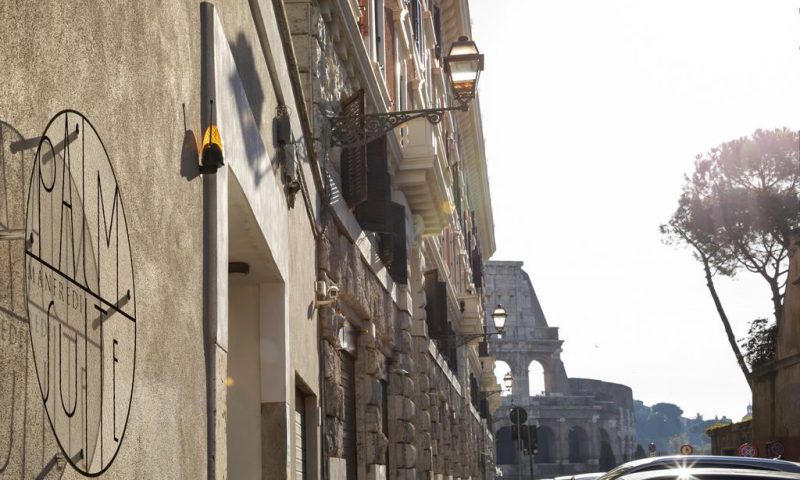
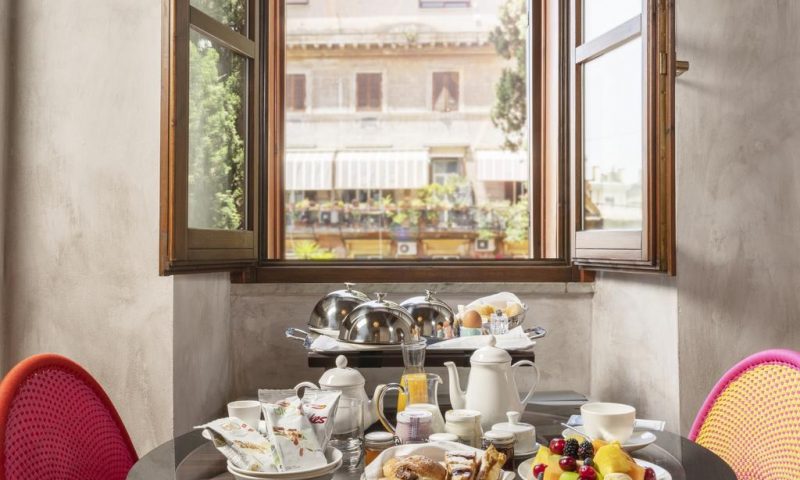
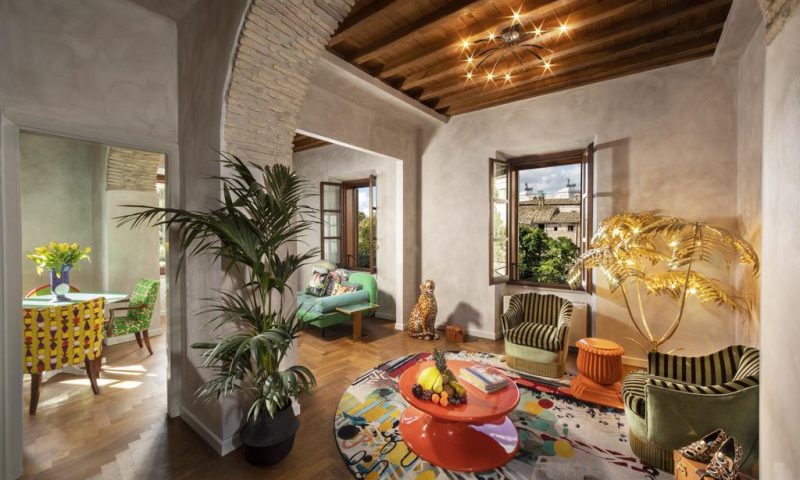
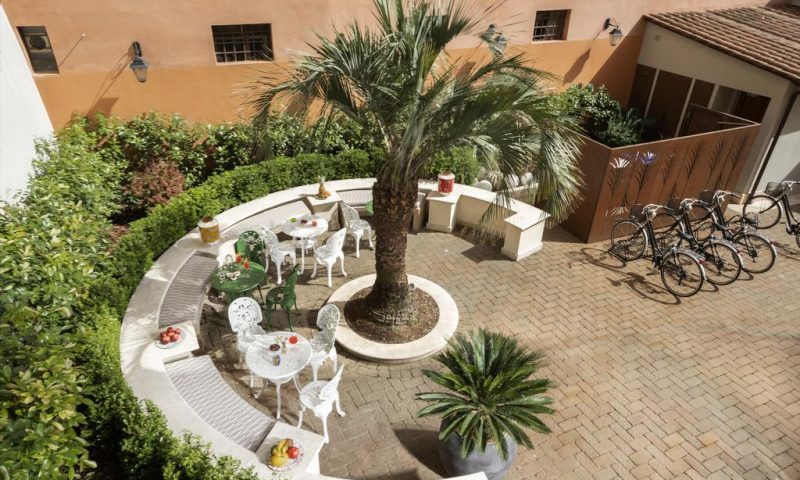
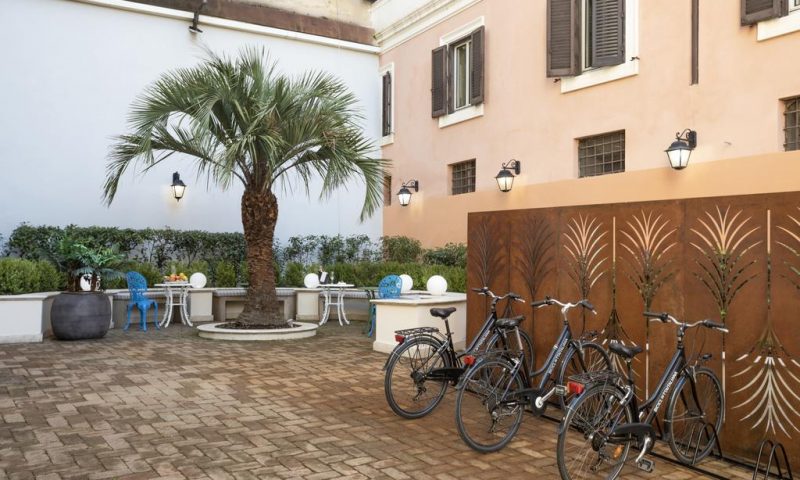
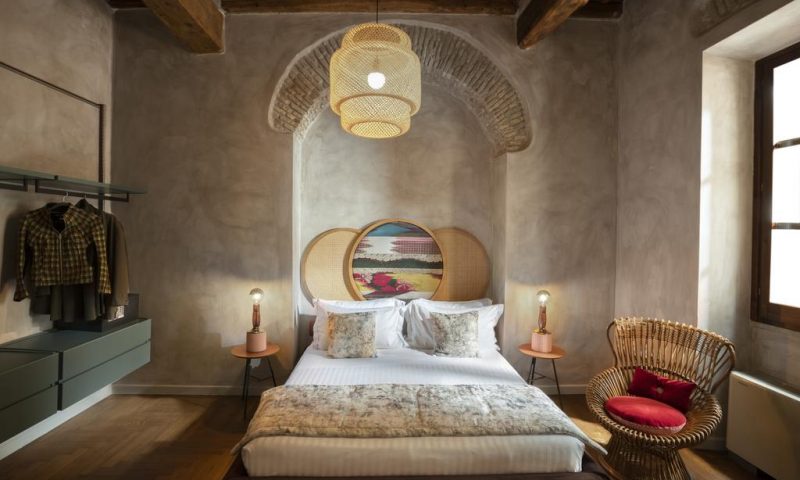
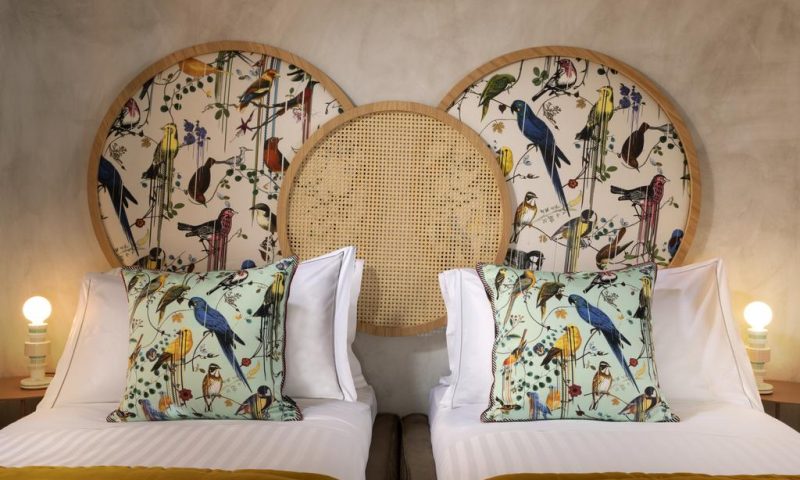
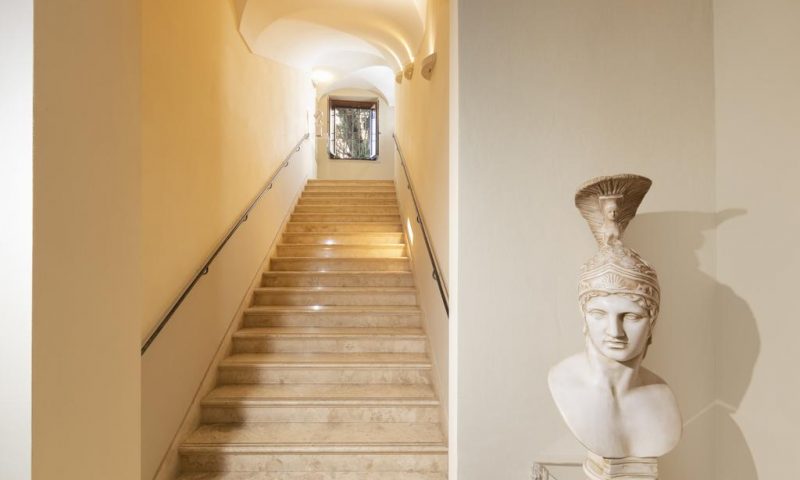
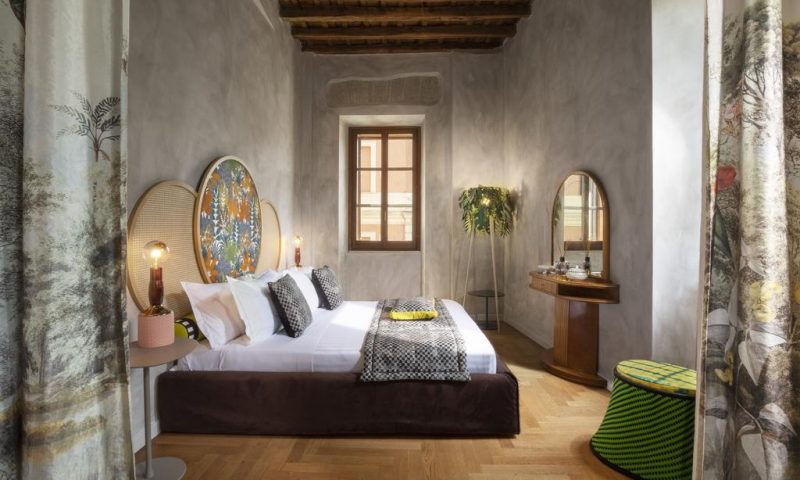
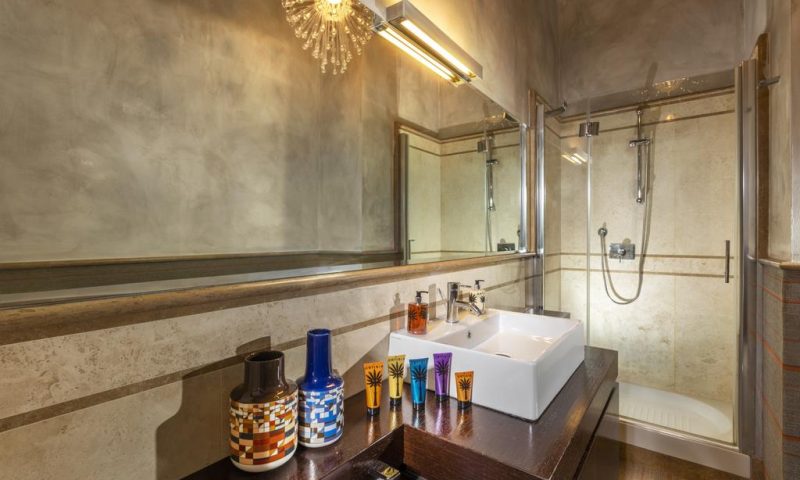
Located in an elegant 18th century building, the PALM SUITE is the perfect combination of charm, comfort and one of a kind stylish interior design. These spacious and elegant suites boast outstanding quality, enhanced by unique furnishings, accessories and stunning views. Guests immediately immerse in an amazing world of imagination and alluring atmosphere.
A unique lifestyle concept that creates a spectacular “home away from home” feeling where warmth and elegance are perfectly combined to make Palm Suite The “place to be”, a hidden gem offering relaxation for couples and families alike.
Each Palm suite is carefully designed to provide our guests absolute and unparalleled lifestyle experience: furniture, lighting and materials all come together to make it a “real home”, a top-end new hospitality concept with complete privacy, spectacular views of the Colosseum and Roman Forum over the iconic palm and magnificent appealing skyline.
AROMA
At Michelin starred AROMA at Palazzo Manfredi, quintessential Rome is reflected in a menu of classic Italian dishes on a picturesque outdoor terrace offering an unparalleled Colosseum view. At 40 seat restaurant is at once intimate and grandiose, ideal for everything from romantic dinners to private parties.
Roman-born Chef Di Iorio has been Aroma’s head chef since it opened in 2010, since which time he has developed a menu that marries his mastery of traditional Italian cooking with his flair fresh ingredients and ideas.
A supporter of sustainable fish, he removed all tuna from the menu, now serving appetizers that showcase lesser known species along with meat options and local produce. His main courses revolve around pasta, featuring five different varieties.
BREAKFAST
Every day is a masterpiece. The sun illuminates the Colosseum and, in the background, its rays bathe imperial Rome and the dome of St. Peter’s Basilica. This is your view at breakfast from the Aroma Restaurant’s terrace on the top floor of Palazzo Manfredi. Enjoy our rich buffet or breakfast à la carte, the choice is yours. Who’d have thought you could admire so much history as you sip a cup of coffee?
PRIVATE EVENTS
Could there be a more beautiful setting in which to celebrate life’s most special moments? From wedding receptions to exclusive cocktails, from business lunches to private parties, the Aroma Restaurant offers the most sophisticated menus and lavish attentions. Everything you could desire for your most exciting events. Starting with the view of the Colosseum and Imperial Rome.
AROMA BISTRO
The Manfredi Fine Hotel Collection’s Palazzo Manfredi in Rome is now home to AROMA Bistro where guests can enjoy a more informal take on the experience offered at the property’s Michelin-starred AROMA Restaurant, at the hands of the same chef.
Diners at AROMA Bistro can expect a faster, more laid-back meal, as dishes are less complex and therefore take less time to prepare, making AROMA Bistro an easy stop to work into an itinerary even on busy days. AROMA Bistro also took a cue from its namesake restaurant’s famous view of the Colosseum by offering a spectacular view of its own.
Diners at the bistro enjoy their meals on a renovated terrace overlooking Roman landmarks Domus Aurea and the Oppian Hill. The respective vistas reflect the difference in tone between the restaurant and bistro.
While both backdrops are quintessentially Roman, the bustling Colosseum looms large, whereas Domus Aurea and the Oppian Hill provide a calmer, quieter backdrop with a rural feel, resplendent with trees and open sky.
LOUNGE BAR
Our splendid American Bar opens onto the Palazzo Manfredi’s superb terrace. This romantic setting, with its chaises longues and small lounges, is ideal for a relaxing break or a quick lunch, a glass of champagne or the finest Italian wine.
All around is the sumptuous beauty of Rome, from the Oppian Hill gardens to the Imperial Fora. By day, the Eternal City basks in the sun, with a backdrop of blue sky. By night, romantic lights sparkle–are they stars, or your eyes?
THE COURT
The Court, honored to be among the Top100 Bars in the world, is the new Cocktail Bar @ Palazzo Manfredi with a stunning view of the Coliseum, one of the world’s wonders and the most prestigious address in Rome. In the Capital City, The Court is the amazing location at the luxurious 5-star hotel Palazzo Manfredi, member of Relais & Chateaux, part of the Manfredi Fine Hotels Collection.
The Bar offers a wide range of innovative drinks with revolutionary techniques by some of the most famous Italian mixologists, right in front of the “Ludus Magnus”, the largest Gladiator training camp in the Antique Rome now dubbed the “most exclusive location for innovative mixology”, where the bartender almost becomes an alchemist.
Behind the counter, this new project is led by world-famous Matteo Zed who is now in Rome after international experiences between Japan and New York City Eclectic, daring, bold and obsessed with Bitters, Matteo is now ready to surprise you.
From the twilight of dusk to midnight, The Court will astonish you with its sublime choice of beverages, its unique location, its elegance and the exceptional techniques.
ROME AND PHOTOGRAPHY
Unique in the world, steeped in history. The Galleria del Cembalo lies at the heart of the Palazzo Borghese, at 19 Largo Fontanella di Borghese, between Piazza di Spagna and the Tiber River, and occupies a number of magnificent ground-floor rooms that Marcantonio IV Borghese had decorated at the end of the 18th century to house his art collection.
The palace soon became a renowned destination for travellers on the Grand Tour. In the 1920s, the exclusive Circolo della Caccia club was inaugurated in the rooms on the palace’s first floor, while the Ripetta wing was rented to the Spanish Embassy. The exhibition space, dedicated to photography lovers and collectors, displays the work of leading Italian and international photographers.
DISCOVER THE ETERNAL CITY
Our Concierge Service would be delighted to book you tickets for Rome’s major museums and to offer you the city’s best guides so that you can relax and enjoy the Eternal City’s masterpieces.
VATICAN MUSEUMS
Who hasn’t dreamed of seeing for themselves the splendour of the Sistine Chapel and the Raphael Rooms? Who hasn’t wanted to lose themselves among the masterpieces of the Vatican Museums? Now you can.
The Vatican Museums house one of the world’s largest collections of art, and cover over 7 km (4 miles). We suggest visiting the Vatican Pinacoteca, with works by Giotto, Leonardo da Vinci, Raphael and Caravaggio, followed by the Collection of Contemporary Art, with works by Francis Bacon, Marc Chagall, Giorgio De Chirico, Paul Gaugin, Vassily Kandinsky, Henri Matisse and Vincent Van Gogh. In the Apostolic Palace you will find the Raphael Roomsand the Sistine Chapel.
THE RAPHAEL ROOMS
This extraordinary cycle of frescoes is Raphael’s greatest masterpiece, painted between 1509 and 1520, the year of the artist’s death. The cycle comprises four rooms:
TTHE ROOM OF THE SEGNATURA
Once the seat of the highest court of the Holy See, the Segnatura Gratiae et Iustitiae, is dedicated to the celebration of knowledge: theology, philosophy, poetry and law. Particularly memorable are the frescoes in the lunette, Disputation over the Most Holy Sacrament, Cardinal and Theological Virtues and the Law, School of Athens and Parnassus.
ROOM OF HELIODORUS
The theme of this room’s decoration was inspired by a military defeat. In the summer of 1511, the pontiff retuned to Rome after a disastrous war against the French. In a climate of great uncertainty, Raphael chose a decorative theme emphasising the protection that God had bestowed on the Church at various moments in history. The four episodes are: Expulsion of Heliodorus from the temple, Mass of Bolsena, Liberation of St Peter and Encounter of Leo the Great with Attila.
ROOM OF THE FIRE IN THE BORGO
This room is the last on which Raphael himself worked directly. The frescoes’ theme is Pope Leo X and his predecessors of the same name, Leo III and Leo IV, depicted in four episodes: Fire in the Borgo, Battle of Ostia, Crowning of Charlemagne and Justification of Leo III.
ROOM OF CONSTANTINE
In 1517, Pope Leo X commissioned Raphael to decorate this room, but the artist only had time to prepare sketches before his death in 1520. Its theme is the life of Constantine the Great and the celebration of the Church’s triumph over paganism. Its four episodes are: Vision of the Cross, Battle of Constantine against Maxentius, Baptism of Constantine, Donation of Rome.
SISTINE CHAPEL
One of the world’s most famous sights, it takes its name from Pope Sistine IV who ordered its construction between 1477 and 1480. The conclave that elects a new pope meets here, under the frescoed ceiling painted by Michelangelo between 1508 and 1512, and behind them, on the far wall, The Last Judgement, painted by the Florentine master between 1535 and 1541.
In April of 1506, Pope Julius II commissioned Michelangelo to decorate the ceiling. Initially, the work was to depict portraits of the 12 apostles. In the end, however, Michelangelo painted over three hundred figures. The entire cycle of the Sistine Chapel depicts the spiritual history of humanity: from creation to the first sin, from Redemption to the end of the world.
BORGHESE GALLERY
How often have you heard the names of extraordinary artists such as Raphael, Caravaggio, Veronese, Bernini, and Canova? How many times have you seen Cranach’s Venus or Titian’s Sacred and Profane Love or Canova’s Paolina Borghese as Venus Victorious, sculpted by Canova? You’ll find all of these masterpieces in the Borghese Gallery.
This magnificent art collection is housed in the Villa Borghese Pinciana, owned by the noble Borghese family since 1580. The core of this collection are the sculptures and paintings of Cardinal Scipione Borghese (1579-1633), nephew of Pope Paul V and future patron of Gian Lorenzo Bernini.
In 1607, Pope Paul V added to his nephew’s collection by giving him 107 paintings confiscated from the painter Giuseppe Cesari, known as the Cavaliere d’Arpino. The following year, Raphael’s The Deposition was added to the collection, secretly seized from the Baglioni Chapel in the Church of St Francis, near Perugia. In 1807, Camillo Borghese sold Napoleon Bonaparte 154 statues, 160 busts, 170 reliefs, 30 columns and various vases that form the Louvre’s Borghese Collection.
MAXXI
Rome is also a vibrant city for contemporary art. MAXXI, the national museum of 21st-century arts, is the leading Italian institution dedicated to contemporary art and one Europe’s most important exhibition centres. Designed by Zaha Hadid, this spectacular building lies in the Flaminio quarter, just a few minutes’ drive from our Hotel.
LUDUS MAGNUS
We are right above it. It is part of our very foundations. The Great Game, as the literal translation of Ludus Magnus goes, was the largest and most important of Rome’s gladiatorial schools, and was located beside the Colosseum, connected to the latter by an underground passage.
Commissioned by Diocletian and situated in the valley between the Esquiline and Caelian hills, the building had the typical layout of a barracks with dormitories and amenities on three floors. At the centre lay an arena, a smaller-scale reproduction of that of the Colosseum.
The ruins of the barracks were discovered in 1937, though much of the structure remains hidden. Did you know that only one-tenth or less of the the ruins of Ancient Rome have been uncovered to date?
COLOSSEUM
Sixty seconds to the Colosseum. Just step out of our hotel, take a few steps, and you’re there, before the largest amphitheatre in the world, the symbol par excellence of Ancient Rome and Italy.
OPPIAN HILL PARK AND THE DOMUS AUREA
A magnificent haven of greenery and shade, home to some of Rome’s most extraordinary treasures. Such is the seductive beauty of Oppian Hill Park unfolding before our hotel.
The starting point is the Domus Aurea, Nero’s city villa built after the terrible fire that devastated Rome in 64 AD. The “Golden House”, designed by architects Celer and Severus, had 300 rooms, swimming pools and fountains. Of particular interest are the grotesques.
Over time, the Domus Aurea were completely buried and the Baths of Trajan were built over much of it. The Domus Aurea was forgotten until, in the 15th century, a boy fell through a hole on the slopes of Oppian Hill and found himself in a strange frescoed cave.
It was a revelation. In no time, artists from Ghirlandaio to Pinturicchio, from Raphael to Michelangelo, had themselves lowered into the cave to view this marvel with their own eyes. The grotesques’ beauty had a profound influence on Renaissance artists.
Proof? Visit the Raphael’s loggia at the Vatican and you’ll see that, in this city, history never ends. Needless to say that Oppian Hill Park is a magnificent place for a walk or an early morning jog.
BASILICA OF SAINT CLEMENT
Rome’s history and the extraordinary passage from the classical to the Christian eras are a stone’s throw from your room. Enter the spectacular Basilica of Saint Clement and discover its incredible structure spanning three floors.
A tip: Start on the lowest level, some 10 metres (30 feet) underground, where you will find two dwellings, one from the 1st century AD, the other from the 2nd century. The courtyard of the latter was turned into a Mithraeum, a temple for worshipping the pagan god Mithras.
Next, climb to the 4th-century basilica on the second level built by the emperor Constantine. Preserved here are the relics of St Cyril, apostle to the Slavs, and some picturesque frescoes depicting the miracle of St Clement, third successor to St Peter.
Ascend one more level and, like Dante, you will “see the stars again” among the stunning mosaics and frescoes of the 12th-century basilica. Lose yourself in the exquisite apse and, whatever you do, don’t miss the cycle of frescoes dedicated to St Catherine painted by Masolino da Panicale at the turn of the 15th century.
THE IMPERIAL FORA
The road to the Imperial Fora begins and ends before us. Fancy a stroll through Imperial Rome? Want to walk through the world’s most spectacular string of squares?
If so, start at the Forum of Caesar, inaugurated in 46 BC. Did you know that Julius Caesar claimed to be descended from Venus and that he personally bought the land on which the temple dedicated to the god was to be built? A short walk away is the Forum of Augustus, inaugurated in 2 BC, with porticoes and exedras where the courts sat.
Sixty years later, the Temple of Peace was built by Vespasian. Then, in 98 AD, the Emperor Domitian connected all of these complexes by building a square linking the Temple of Peace to the Forums of Caesar and Augustus. The last imperial forum to be built was Trajan’s, inaugurated in 113 BC and financed with the spoils from the conquest of Dacia.
ROMAN FORUM
This was the commercial, religious and political heart of Rome, and lay in the valley between the Palatine and Capitoline hills. The Roman historian Livy wrote that shortly after the founding of Rome, in 753 BC, a violent battle was fought between the Romans and the Sabines in the area where the future forum would stand.
During the battle, Romulus, seeing his soldiers retreat, invoked Jupiter, promising to build a temple dedicated to him if the Romans were victorious. The attack recommenced. At that very moment, the Sabine women, who had been kidnapped by the Romans, threw themselves between the two armies begging for peace.
The finishing touches to the Roman Forum were made in the imperial era, begun by Caesar and completed by Augustus, with the construction of new temples and magnificent squares. Later, in the 4th century, the monumental Basilica of Maxentius was built under Emperor Maxentius, and was designed as place where legal matters could be transacted.
At the fall of the Roman Empire and during the Middle Ages, the Forum gradually became buried and was used as a pasture, from which it took the name “Campo Vaccino” or “Cow Pasture”.
The fatal blow, however, was inflicted by Pope Julius II, who sat from 1503 to 1513, and who decided to use the area as a quarry for reusable materials, often turning them into lime. The protests of Michelangelo and Raphael fell on deaf ears.
CAPITOLINE HILL AND THE CAPITOLINE MUSEUMS
Rome was born here, on Capitoline Hill. According to legend, the god Saturn created the first settlement here, in which the Greeks, led by Hercules, were welcomed. The hill probably takes its name from the head, “caput” in Latin, of a warrior named Tolo or Olo, which was unearthed during excavations for the foundations of the Temple of Jupiter Capitolinus, which was dedicated to Jupiter, Juno and Minerva.
During the imperial era, Augustus built a small temple dedicated to Mars on the Capitolium, to which were later added other temples commissioned by Titus, Hadrian and Marcus Aurelius. By that time, the Capitoline Hill had become a place of worship and the destination for processions and victory parades.
During the Renaissance, Pope Paul III commissioned Michelangelo to design the Capitoline Square. In 1539, the great architect, sculptor and painter placed at the square’s centre the Equestrian Statue of Marcus Aurelius, sculpted in 176 BC (today, a copy stands in its place, with the original kept in the Capitoline Museums). He also designed new access steps, the Cordonata, allowing the hill to be ascended on horseback.
Today, the Capitoline Square is flanked by the splendid Capitoline Museums. May we suggest at least four statues that are true masterpieces? The Capitoline Wolf, symbol of the city and Mater Romanorum, the Capitoline Venus, the Dying Galatian and Cupid and Psyche. Love Caravaggio? Then don’t miss “St John the Baptist”, painted by the artist in 1603.
MAGNIFICENT ITINERARIES
Rome’s surrounding area is as magnificent as the city itself. Our Concierge would be delighted to suggest the most interesting itineraries and organise the very best chauffeured car service for you. Or perhaps you would prefer to rent a Ferrari and drive yourself out to beautiful sights such as the Castelli Romani, Tivoli or Hadrian’s Villa?
ROMAN CASTLES
Lying in the famous Alban Hills are 13 picturesque towns that have been tourist destinations since the Roman Empire. You won’t want to miss Frascati, dominated by the 16th-century Villa Aldobrandini, or Grottaferrata, where you can visit the Abbazia Greca di San Nilo, founded in 1004 by monks from Byzantine Calabria.
Then there’s Castel Gandolfo, the Pope’s summer retreat, and Nemi, where a must-see is the Roman Ship Museum, built in the 1930s to display the Roman ships discovered at the bottom of Lake Nemi.
HADRIAN’S VILLA
Hadrian’s Villa, about 25 km (15 miles) from Rome, is one of the most spectacular imperial palaces and a UNESCO World Heritage Site. Built by Emperor Hadrian between 126 and 138 AD over an area of 120 hectares (297 acres), the villa is a masterpiece showcasing the finest ancient Mediterranean architecture and sculpture.
The villa reproduces the places and buildings that most impressed the Emperor on his travels, such as the Lyceum and the Platonic Academy in Athens, the Canopus Canal on the Nile Delta and the Vale of Tempe in Thessaly.
TIVOLI
If you are planning to visit Hadrian’s Villa, you should also visit beautiful Tivoli, just 25 km (15 miles) away from Rome, and the enchanting Villa d’Este, built in 1550 by Cardinal Ippolito d’Este. The villa is famous for its artistic treasures and the jeux d’eau of its magnificent fountains.
Rooms: 10
Price: from 369 EUR per night
——————————————————————————
Write us to receive our best offer for the
PALM SUITE ROME
——————————————————————————
Source: www.palmsuiterome.com
Deals of the day
Parador de Cuenca
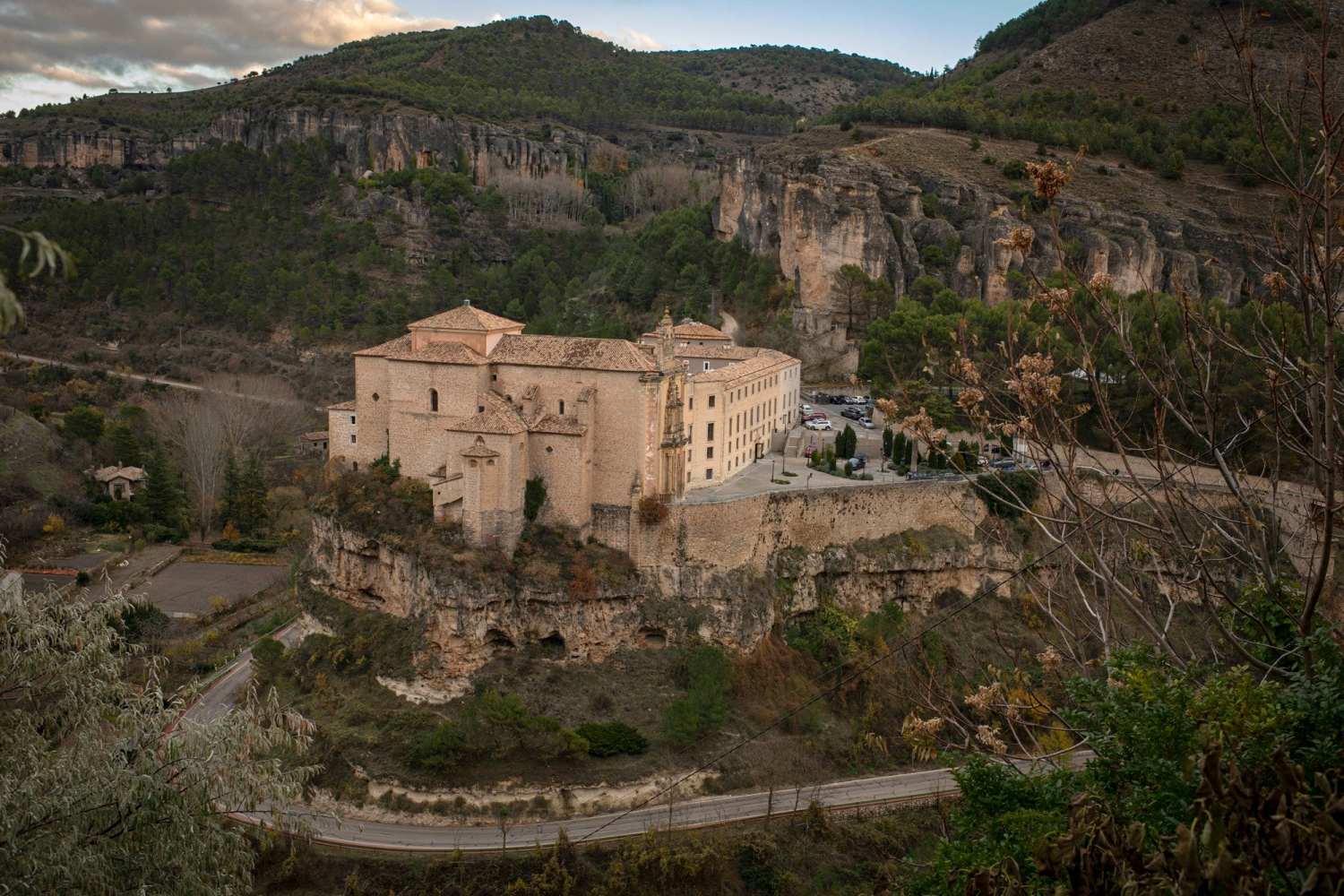
The Parador de Cuenca is a destination in itself. It’s located in a 16th century convent originally built for the Dominican order and it’s one of the most representative monuments of the city today. It’s located in one of the most special places in the city, next to the San Pablo bridge and opposite the Casas Colgadas or Hanging Houses. The convent of San Pablo has a beautiful glazed cloister with semi-circular arches and a…
Black Rhino Game Lodge
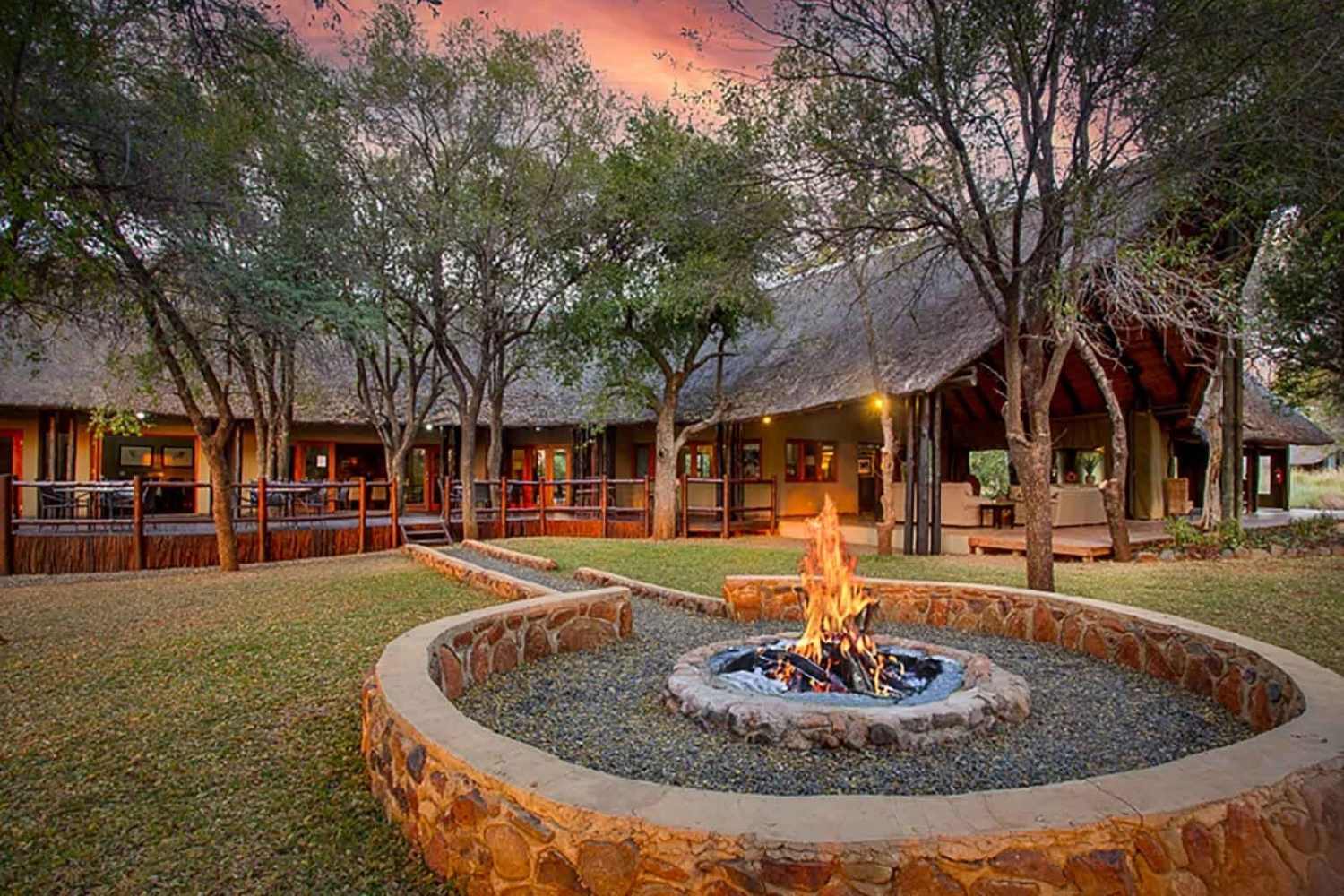
Black Rhino Game Lodge is a luxury safari lodge located in the North West Province of South Africa, in the malaria-free Pilanesberg National Park. The lodge is situated in a prime location for game viewing, with access to over 55,000 hectares of wilderness. Black Rhino Game Lodge offers a variety of safari activities that allow guests to experience the beauty and wildlife of the African bushveld. The Pilanesberg National Park…
Hotel Nidwaldnerhof Beckenried
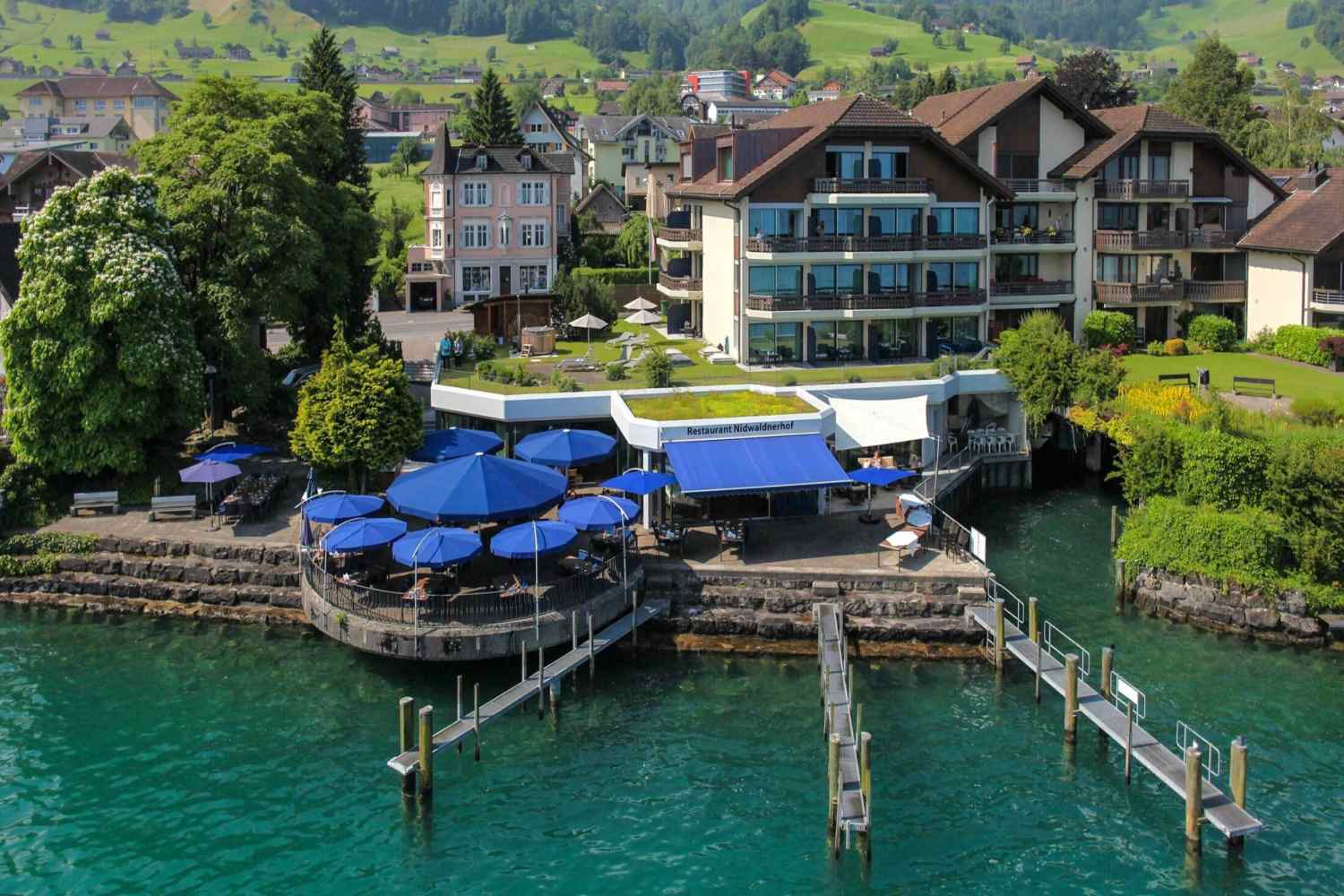
About 100 years ago the Nidwaldnerhof was known as Park-Hotel Nidwaldnerhof. “In a favoured, open location, with a large covered terrace, directly beside the lake. Many rooms with balconies. Music salon. Electric lighting. Shady park with 400 m of shoreline and magnificent all-round views. Choice cuisine…” according to the brochure available at the time. In 1979 the Park-Hotel Nidwaldnerhof was torn down and today’s…
George Zero Street Charleston
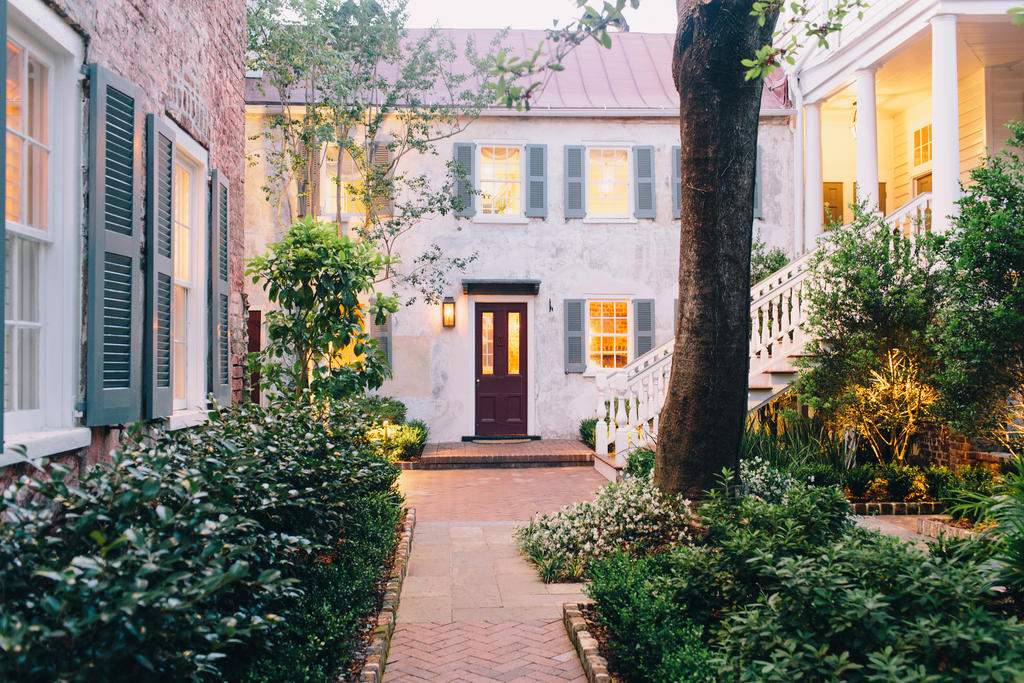
Named after our actual street address, Zero George is comprised of sixteen lush guest rooms and studios in three painstakingly restored historic residences and two brick carriage houses that surround our private garden courtyard. We’ve infused it all with a sense of intimacy and warm personality, honoring the buildings’ solid 1804 bones and graceful architecture with measured, timeless design. At Zero George, you’ll…
Chateau De Sacy Reims
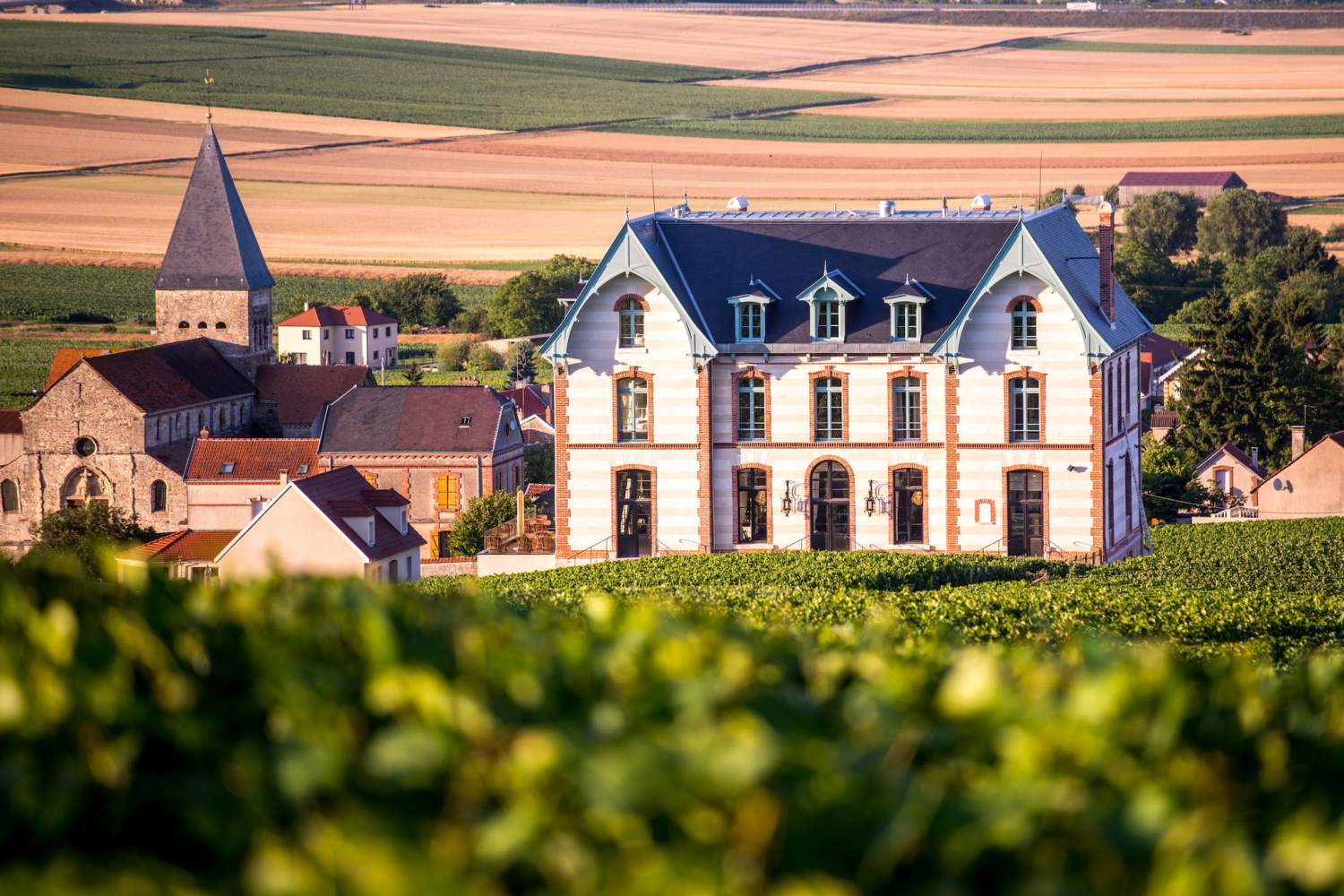
The Chateau de Sacy, surrrounded by vineyards on the outskirts of Reims, dates back in its original state to the middle of the 19th century, but in its present form it’s been thoroughly transformed — the Château de Sacy is a fantasy more romantic than the real thing, a luxe and lavish 12-room hotel that incorporates a multitude of historical styles, and a bit of modernity as well. The spa includes barrel-style hot tubs with…
Borgo Pignano Volterra
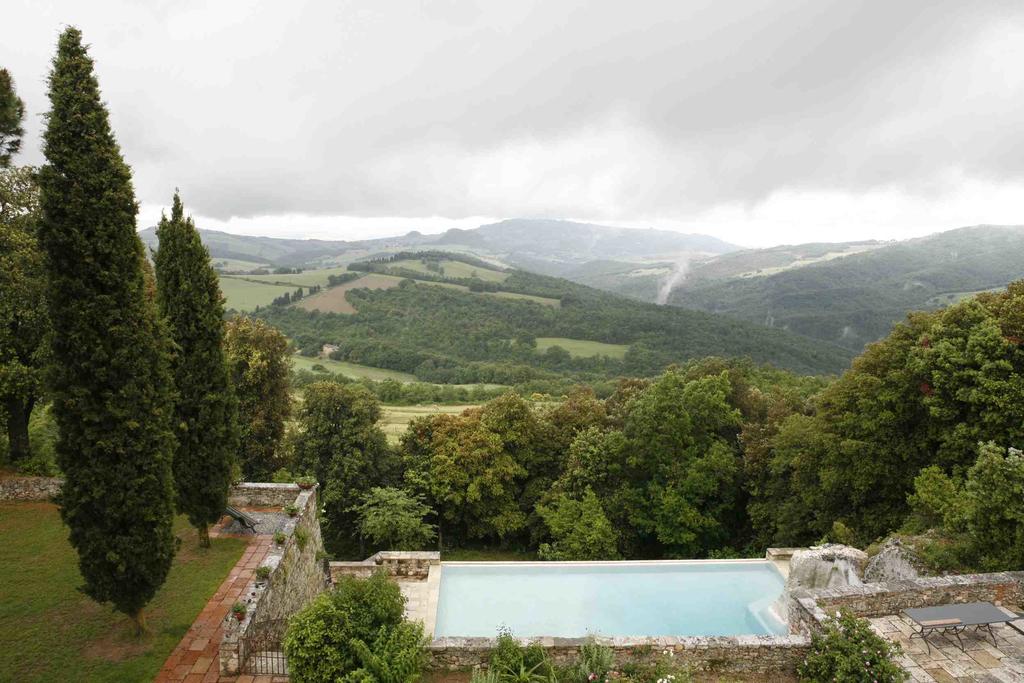
Deep in the heart of historic Tuscany lies an enchanting haven of peace and tranquillity. At Borgo Pignano you will discover a beautifully restored country estate offering an exclusive combination of elegant accommodation, exceptional comfort and gracious hospitality. Borgo Pignano is an elegant country estate in the heart of the Tuscan countryside, just a short drive from the historic, hill towns of Volterra and…
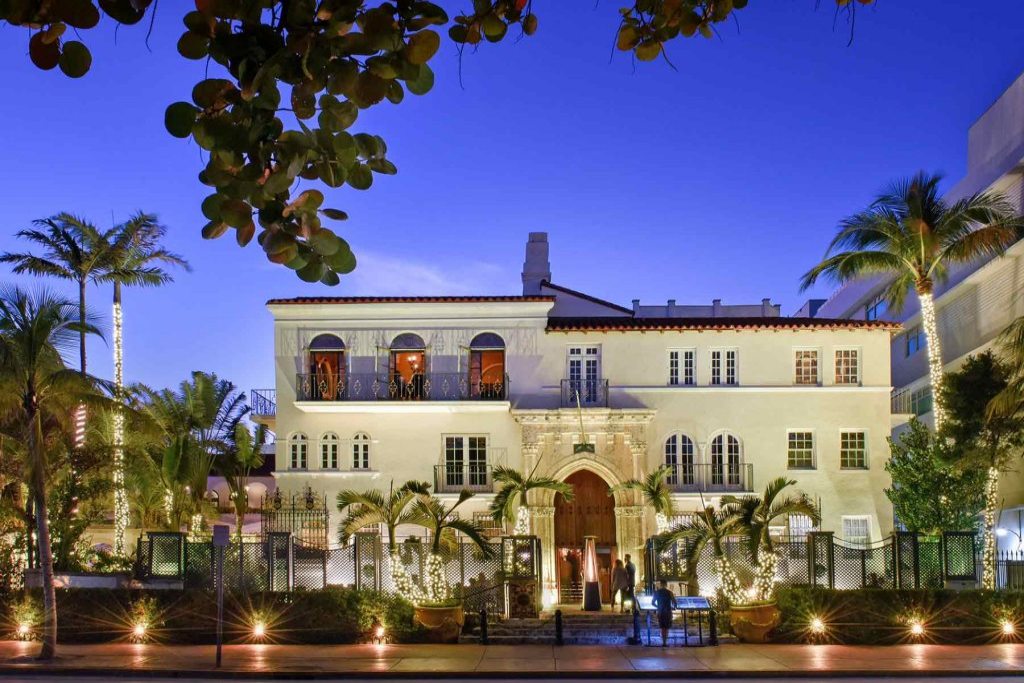
Casa Casuarina Miami
Casa Casuarina was built in 1930 by Alden Freeman. Alden Freeman’s father, Joel Freeman was Treasurer of The Standard Oil Trust (also known as Rockefeller’s Company) and left Alden a fabulous wealth when he passed away. That gave the young and wealthy Alden the opportunity to retire at the age of 27 from being an architect and travel all over the world. Alden was also a descendent of the Mayflower on his mother’s side…
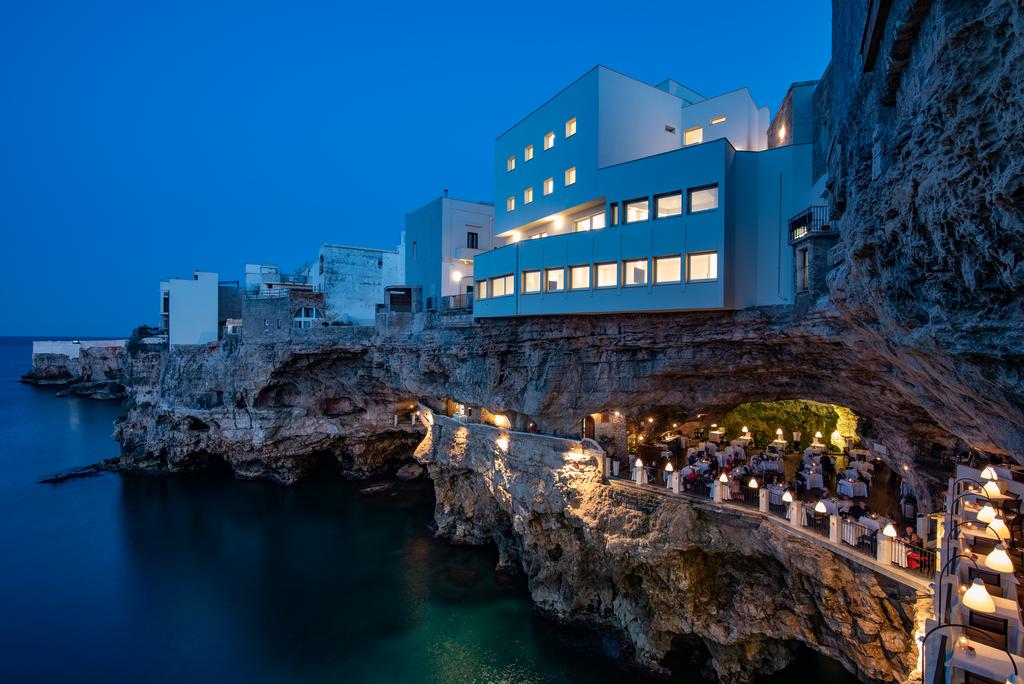
Hotel Grotta Palazzese Polignano a Mare
Naturalis Bio Resort is an exclusive Charming Residence, situated on a promontory with a view of the Salento countryside. Naturalis Bio Resort & Spa is the result of a fine and careful renovation of an ancient rural village surrounded by typical dry stone walls and protected by majestic old olive trees. A unique hotel facility, the most authentic rural tradition of Salento and our careful hospitality, perfectly come…
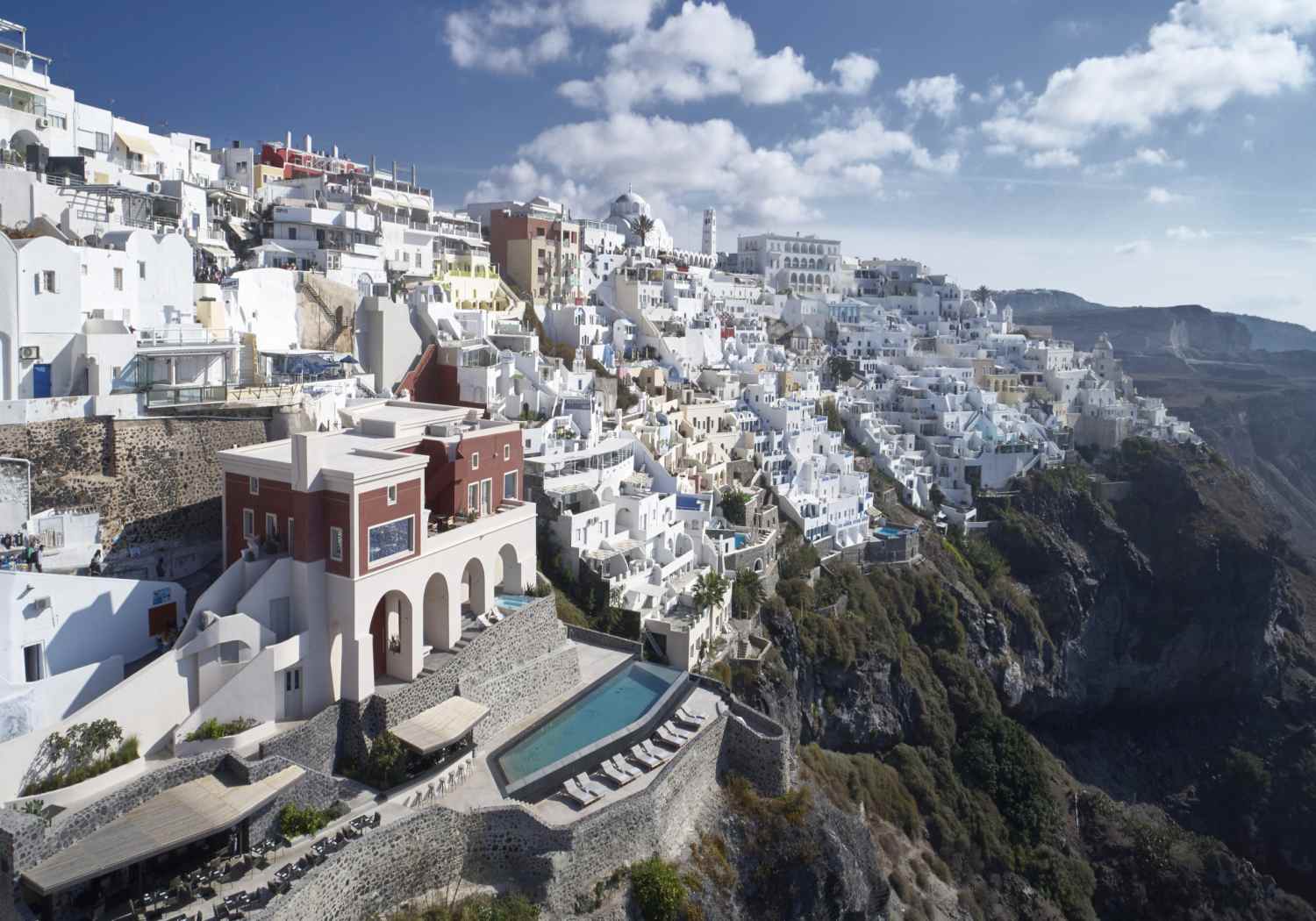
Villa Bordeaux Santorini
Inspired by the traditional architecture of the Cyclades, the exceptional Santorini Luxury Suites of Villa Bordeaux are part of an authentic neoclassical house. They have been restored so as to preserve the charm and character of a bygone era while at the same time offer all indulgences and comforts of modern life. Spacious, elegant and chic, all 4 luxury suites in Fira Santorini are fitted with fine furnishings and…
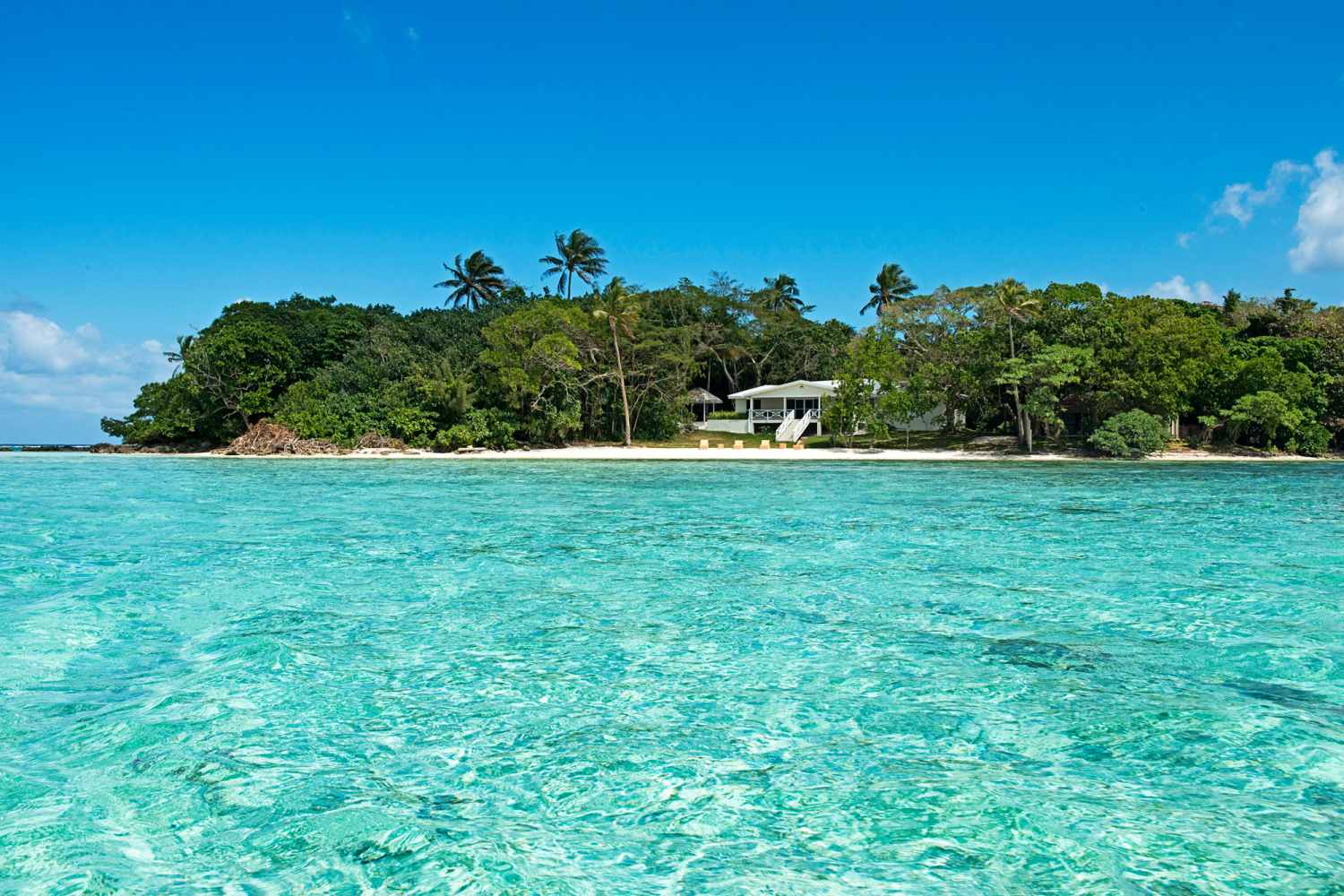
Erakor Island Resort & Spa Vanuatu
We look forward to sharing our culture, our customs and our beautiful smol aelan (small island) with you. Whether you are coming for a family holiday, reunion, tropical wedding, honeymoon, friends’ get-together or a relaxing break, we look forward to meeting you and sharing our culture and customs, along with plenty of Vanuatu smiles! There is so much to do and enjoy on this fabulous little island and when you…